How to Scrape Real Estate Listings from Popular Property Sites
Recent industry reports show that most home buyers now begin their property search online. This shift has made property data one of the most valuable assets in the housing market. Investors, brokers, and property platforms increasingly rely on real estate web scraping to collect accurate listing information at scale. Instead of depending on slow manual research, businesses want faster and more reliable ways to track prices, locations, and market trends.
The demand for automated data extraction in real estate continues to grow as competition increases. Companies that use structured property data can make smarter pricing decisions and spot new opportunities earlier. This is where experienced providers like TagX help. TagX delivers clean, well organized property datasets that support market research, competitor tracking, and business intelligence without adding operational complexity.
What is Real Estate Web Scraping and Why It Matters
Real estate businesses depend on fresh and well structured property data to stay competitive. This is why automated data collection has become a key part of modern property intelligence.
Real estate web scraping is the process of automatically collecting property information from online listing platforms. Instead of copying details by hand, companies use automated methods to gather large volumes of data quickly and accurately. This approach saves time and reduces human error.
In practice, real estate scraping supports deeper market analysis. Businesses can track price changes, monitor inventory levels, and study demand patterns across different locations. As a result, decision makers gain a clearer view of market movements and investment opportunities.
Many groups rely on this data. Real estate brokers use it to compare listings and guide clients. Investors analyze trends to find profitable properties. Aggregator platforms depend on large datasets to build comprehensive property portals.
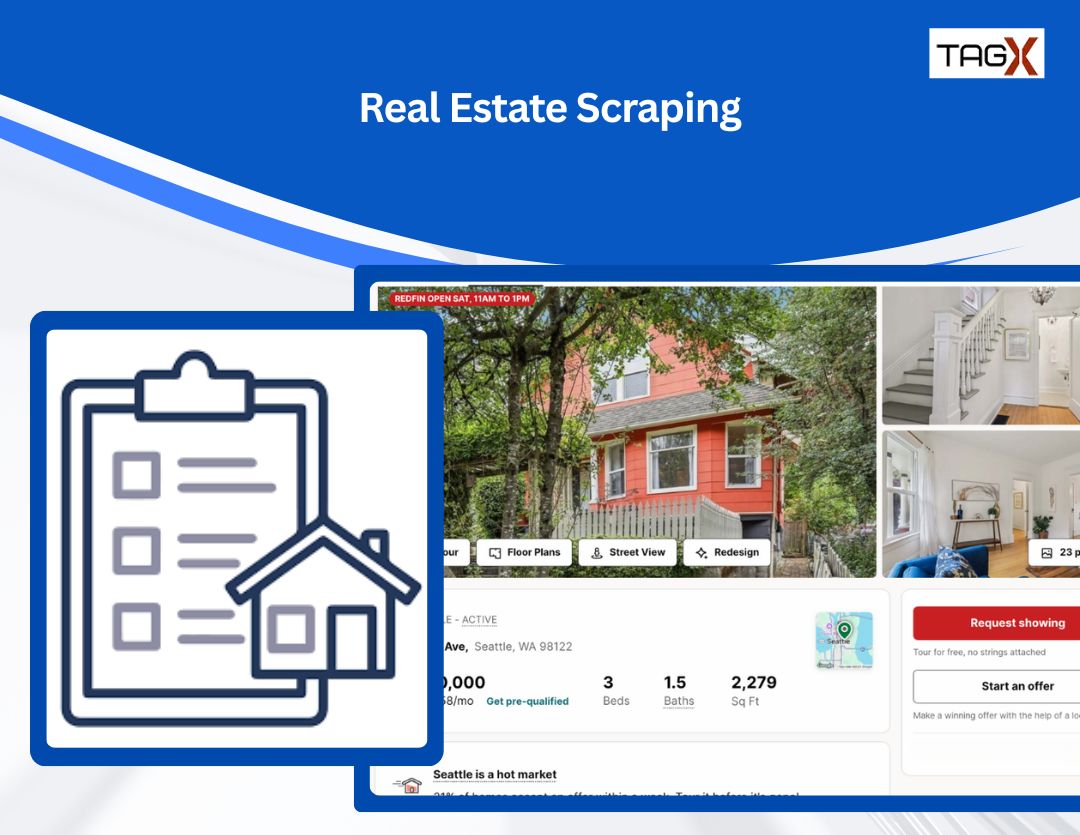
The types of property data collected often include listing prices, property features, location details, agent information, images, and availability status. When organized properly, this data becomes a powerful asset for market research and strategic planning.
Read more: What companies specialize in web scraping for real estate listings
Key Benefits of Scraping Property Listings for Businesses
Property data has become a major competitive asset in today’s real estate market. Businesses that use automated data collection gain faster insights and make smarter decisions.
By scraping property listings, companies can monitor large volumes of market information without manual effort. When organizations scrape real estate data in a structured way, they unlock several strategic advantages:
- Market trend analysis: Businesses can track price movements, supply levels, and demand patterns across regions. This helps teams understand where the market is heading and respond quickly.
- Competitive pricing intelligence: Access to competitor listings allows companies to benchmark pricing strategies. As a result, brokers and platforms can price properties more accurately and stay competitive.
- Lead generation opportunities: Fresh listing data helps identify new sellers, buyers, and rental prospects. This creates a steady pipeline of qualified leads for sales and marketing teams.
- Portfolio expansion insights: Investors can discover emerging neighborhoods and high-potential property types. This supports smarter portfolio growth and diversification.
- Better investment decisions: With clean and organized data, decision makers reduce guesswork. They can evaluate risks, compare opportunities, and move forward with greater confidence.
When used correctly, automated property data collection turns raw listings into meaningful business intelligence.
Popular Property Websites Used for Web Scraping Real Estate
Online property platforms hold massive volumes of housing data across regions and property types. That is why businesses focus on web scraping real estate platforms to build strong and reliable datasets.
Companies that scrape real estate listings from trusted property sites can monitor market activity, pricing shifts, and inventory changes more efficiently. Below are the main types of platforms that provide valuable property data.
Marketplaces and Listing Portals
Large property marketplaces are often the primary data source. These platforms host thousands of active listings from agents, builders, and individual sellers. They typically provide rich details such as price, location, property size, and amenities, making them highly valuable for market research.
Rental Platforms
Rental-focused websites are essential for tracking lease trends and tenant demand. Businesses use these platforms to study rental pricing, occupancy patterns, and neighborhood-level demand. This data is especially useful for property managers and rental aggregators.
Commercial Property Portals
Commercial real estate platforms specialize in office spaces, retail units, warehouses, and industrial properties. These portals help investors and brokers understand commercial availability, pricing benchmarks, and emerging business districts.
Regional Real Estate Sites
Local and regional property websites often contain niche market data that large portals may miss. These sources help businesses capture hyperlocal trends, especially in fast-growing or underserved markets.
Data Fields Typically Extracted
When collecting property data, businesses usually focus on key fields such as:
- Listing price
- Property type
- Location and neighborhood
- Property size and features
- Agent or seller details
- Listing status and availability
- Property images
Well-structured extraction of these fields helps transform raw listings into actionable market intelligence.
Step-by-Step Process for Real Estate Data Scraping
A clear and structured workflow is essential for building accurate property datasets. Without the right process, businesses risk collecting incomplete or inconsistent information.
Successful real estate data scraping depends on careful planning, smart automation, and strong data validation, especially when scraping property listings at scale. Below is a practical, SEO friendly process that helps teams collect reliable real estate data.
Define Your Data Requirements
Start by listing the exact data fields your business needs. Common fields include listing price, property type, square footage, location, amenities, agent name, and availability status.
From a technical standpoint, create a data schema or field map before extraction begins. This ensures consistency across all records and makes downstream analysis much easier.
Identify Target Property Platforms
Next, select the property websites that align with your market goals. Focus on platforms with high listing volume, frequent updates, and strong regional coverage.
Technically, review the site structure, pagination pattern, and content loading method. Many modern property sites use dynamic content loading, so understanding the page behavior early prevents data gaps later.
Configure Data Extraction Workflows
This is where automation becomes critical. Set up structured extraction workflows that can systematically navigate listing pages, property detail pages, and pagination layers.
Best practices include:
- Handling pagination and infinite scroll properly
- Managing session headers and request patterns
- Scheduling automated runs at defined intervals
- Respecting website policies and compliance requirements
A well-configured workflow ensures scalable and consistent data capture.
Clean and Structure the Dataset
Raw property data often contains duplicates, inconsistent formats, and missing values. Data cleaning is essential for SEO grade analytics and reporting.
Important technical steps include:
- Removing duplicate listings
- Standardizing price and area formats
- Normalizing location data
- Filling or flagging missing fields
- Converting data into structured formats such as CSV or JSON
Clean data improves accuracy in market analysis and search visibility.
Validate and Deliver Data
Before final delivery, perform automated and manual quality checks. Validate record counts, field completeness, and formatting accuracy.
High quality providers also implement:
- Data accuracy audits
- Sample verification
- Error logging and monitoring
- Secure data delivery pipelines
Once validated, the structured dataset is ready to support pricing intelligence, market research, and property analytics at scale.
Get clean, structured property data at scale with TagX.
Common Challenges in Real Estate Web Scraping
Collecting property data at scale is not always straightforward. Real estate web scraping projects often face technical and compliance hurdles that require careful planning.
When businesses scrape real estate listings, they must be prepared to handle the following common challenges:
- Anti-bot protections: Many property websites use rate limiting, CAPTCHA, IP blocking, and behavioral detection systems. These measures can interrupt automated data collection if not handled properly.
- Dynamic content loading: Modern real estate platforms often load listings using JavaScript, infinite scroll, or AJAX calls. This makes data extraction more complex compared to static web pages.
- Data accuracy issues: Property listings frequently change. Prices update, homes get sold, and details are edited. Without proper validation and refresh cycles, datasets can quickly become outdated or inconsistent.
- Compliance considerations: Every real estate data project must respect website terms of use, privacy rules, and regional data regulations. Ignoring compliance can create legal and reputational risks.
- Large scale data handling: Extracting thousands or millions of listings generates massive datasets. Businesses need strong data pipelines, storage planning, and quality checks to manage this volume efficiently.
How Professional Real Estate Data Scraping Services Add Value
As property markets become more data-driven, many businesses are turning to expert providers for reliable data support. Professional real estate data scraping services help companies scale their data operations while maintaining strong accuracy and consistency. Choosing one of the best real estate scraping services allows organizations to access structured and clean property datasets without the burden of manual collection.
This reduces internal workload, supports compliance-aware data practices, and ensures ongoing delivery of updated listing information. With the right partner, businesses can focus more on market strategy and less on data gathering. TagX supports real estate companies with customized data services designed to meet growing market demands.
What Makes the Best Real Estate Scrapers Stand Out
Not all providers deliver the same level of quality and reliability. Businesses must evaluate several key factors before choosing among the best real estate scrapers in the market.
Strong real estate scraping performance depends on accuracy, coverage, and the ability to deliver data in a business ready format. Here are the main criteria that separate top providers from the rest.
Data Accuracy Standards
High performing providers prioritize data validation at every stage. This includes duplicate removal, field verification, and consistency checks. Accurate data helps businesses make confident pricing and investment decisions.
Coverage Across Platforms
Leading providers collect property data from multiple listing portals, rental platforms, and regional sites. Broader coverage gives businesses a more complete view of the market and reduces blind spots.
Custom Data Delivery
Every real estate business has different data needs. Top providers offer flexible delivery formats such as CSV, JSON, or database ready files. Custom field mapping also ensures the dataset fits smoothly into internal systems.
Data Normalization
Property listings often come in inconsistent formats across websites. Quality providers standardize pricing, location names, property types, and measurement units. This normalization makes analysis faster and more reliable.
Enterprise Scalability
As data needs grow, the provider must handle higher volumes without performance drops. Enterprise-ready workflows, automated pipelines, and strong infrastructure allow businesses to scale confidently.
Read also: Best Real Estate Web Scraping Services for Property Listings
Why Choose TagX for Real Estate Data Scraping
Choosing the right data partner can directly impact the quality and reliability of your property intelligence. TagX brings proven experience and a business-focused approach to help companies scale with confidence.
With advanced real estate data scraping services, TagX helps organizations scrape real estate data efficiently while maintaining strong data accuracy standards. Our approach to real estate web scraping focuses on delivering clean, structured, and analysis-ready datasets that support real business outcomes.
Large Scale Data Expertise
TagX handles complex, high-volume property data projects for growing businesses.
- Processes large datasets across multiple property platforms
- Maintains consistency even at high data volumes
- Supports expanding geographic coverage
- Built for enterprise-level data needs
Custom Extraction Workflows
We design workflows based on your exact business and market requirements.
- Flexible field-level data capture
- Platform-specific extraction logic
- Support for multiple property categories
- Workflows aligned with business goals
High Quality Structured Datasets
Data quality is at the center of our delivery process.
- Standardized and normalized property fields
- Duplicate listing removal
- Clean and analysis-ready formats
- Quality validation before delivery
Industry Focused Approach
Our team understands how real estate businesses use property data.
- Built for brokers, investors, and aggregators
- Supports market research and pricing analysis
- Designed for competitive intelligence
- Aligned with real-world real estate use cases
Dedicated Support
TagX provides ongoing assistance to ensure smooth data operations.
- Responsive technical support
- Continuous data monitoring
- Reliable delivery schedules
- Long-term partnership approach
If your business is looking to scale property intelligence with confidence, TagX delivers the reliability and flexibility modern real estate teams need.
Conclusion
In today’s fast-moving property market, automated data collection has become essential for businesses that want to stay competitive. Real estate web scraping enables companies to access large volumes of structured property data, helping them track market trends, refine pricing strategies, and uncover new growth opportunities.
When done correctly, automated property data supports smarter decisions, reduces manual effort, and improves overall market visibility. That is why many real estate platforms, investors, and brokers are partnering with experienced providers to strengthen their data capabilities.
If you are ready to scale your property intelligence with reliable and well-structured datasets, TagX is here to help. Contact TagX today to discuss your real estate data requirements and discover how our tailored services can support your next phase of growth.