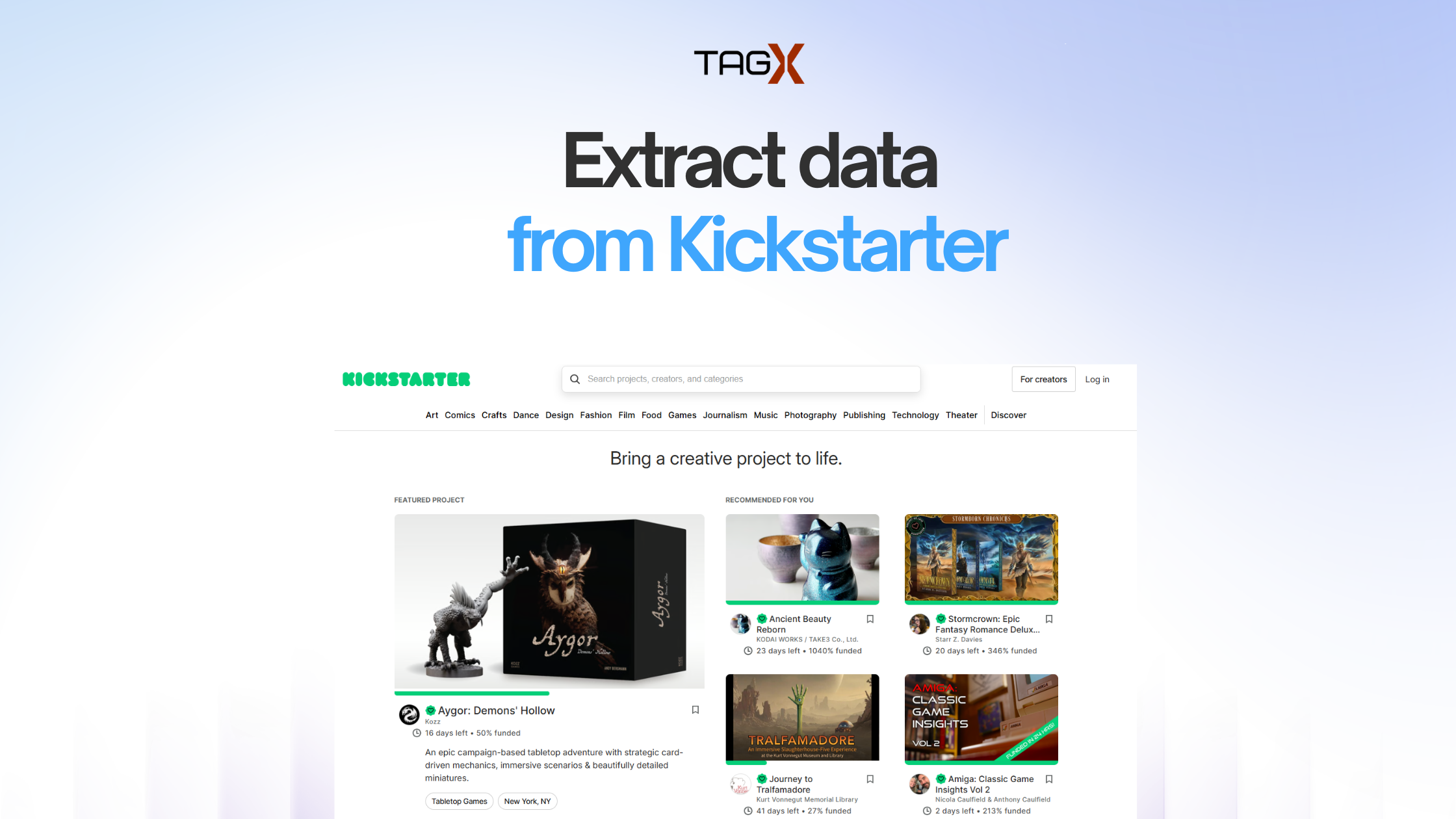
How to extract data from Kickstarter
Kickstarter hosts thousands of live projects at any given time, with new ideas launching and getting funded every day. That means a constant flow of Kickstarter data is available for anyone who wants to understand trends, products, and what people are actually supporting.
I’ve been looking into this myself, and I know you’re probably running into the same problem… trying to extract data from Kickstarter, but ending up with scattered information and too much manual work.
So let me ask you this:
How do you actually collect useful Kickstarter data without things getting messy or time-consuming?
At first, it looks simple. You open a few pages, note down details, and everything feels under control. But after a few more projects, the structure starts to break. Data is spread across multiple pages, updates keep happening, and it’s hard to keep everything consistent.
This is where people start exploring different approaches like a Kickstarter scraper, checking if a Kickstarter API can help, or trying to scrape Kickstarter pages more efficiently. Some go deeper into Kickstarter web scraping to build a reliable Kickstarter dataset for analysis.
The key is not just to extract data from Kickstarter, but to do it in a way that saves time and gives you clean, usable data.
Why Kickstarter Data Matters for Research and Business
Every project shows what people are willing to support, how much they spend, and which ideas gain attention. This kind of Kickstarter data gives a clear picture of market demand without guesswork.
So what kind of data can you actually find?
You can track several important data points, such as:
- Funding goal and total amount pledged
- Number of backers supporting a project
- Project categories like tech, design, games, and more
- Campaign duration and launch timelines
- Updates and engagement during the campaign
When you look at this data together, it starts to form clear patterns instead of random numbers.
Now think about this for a second. What if you could use this data to predict what might work next?
That’s exactly what many businesses and analysts focus on.
Brands study campaign performance to spot trends early. They look at which products get funded quickly and which ones fail to gain traction. This helps them plan better product launches and pricing strategies.
At the same time, analysts use this data to:
- Measure success rates across different categories
- Compare performance between similar projects
- Understand backer behavior and funding trends
- Build insights for research and reporting
In simple terms, Kickstarter is not just about projects. It is a window into what people want. And when you use the data correctly, it helps you make smarter and more confident decisions.
Get clean, scalable Kickstarter data with TagX.
Kickstarter API vs Web Scraping: What Works Better
When people try to extract data from Kickstarter, the first thing they look for is a Kickstarter API. It sounds simple. Connect, pull the data, and move on.
But here’s the reality. Kickstarter does not provide a fully open API for public data access.
So what does that mean for you?
It means you cannot depend on an API if you want complete and consistent data. This is why many businesses and analysts rely on Kickstarter web scraping to collect the information they need.
Let’s break this down clearly.
What You Get with Kickstarter API
API access is structured and easy to handle. But it comes with limits.
- Data is clean and organized
- Easy to integrate into systems
- Limited access to full project details
- No flexibility for large-scale data collection
In short, it works well for small use cases but not for deep analysis.
What You Get with Kickstarter Web Scraping
Scraping gives you direct access to live project pages.
- Access to detailed campaign data
- Covers funding, backers, updates, and more
- Works for large-scale data collection
- Requires processing to clean and structure data
This approach gives you more control, even though it needs extra effort.
Structured vs Unstructured Data
Here’s a simple way to understand the difference:
- API data is structured. It is clean and ready to use.
- Scraped data is unstructured at first. It needs to be cleaned and organized.
But once processed, scraped data becomes just as useful and often more complete.
So, What Works Better?
If your goal is basic access, an API might be enough.
But if you want to extract data from Kickstarter at scale, with full project details and real-time updates, scraping is the better choice.
Most real-world use cases lean toward scraping because it provides a deeper and more flexible view of the data.
Step-by-Step Process to Extract Data from Kickstarter
If you plan to scrape Kickstarter pages, it may look easy in the beginning. You open a few projects, copy details, and move on.
But here’s the reality.
“At first, it looks like simple copy-paste. But once you scale beyond a few pages, the process becomes much more complex.”
So how do you actually do it the right way?
1. Find the Right Project Pages
Start by identifying which pages matter to you. Kickstarter has thousands of live and past campaigns.
You can filter by:
- Categories such as tech, design, or games
- Popular or trending projects
- Recently launched campaigns
This helps you focus only on relevant data instead of collecting everything.
2. Identify Key Data Points
Next, decide what information you need before you start collecting.
Common data points include:
- Project title and description
- Funding goal and pledged amount
- Number of backers
- Campaign duration and updates
This step keeps your data structured from the start.
3. Handle Pagination and Categories
Kickstarter data is spread across multiple pages. You will need to move through listings and categories to collect complete data.
- Projects are not on a single page
- New campaigns keep getting added
- Categories have separate sections
A reliable Kickstarter scraper should be able to navigate across pages and collect data without missing entries.
4. Collect and Store the Data
Once data is extracted, the next step is organizing it properly.
- Store data in formats like CSV or JSON
- Keep fields consistent across all entries
- Remove duplicates and errors
Clean data is what makes analysis easier later.
Final Thought
The process is not just about collecting data. It is about collecting the right data in a structured way.
When done correctly, you can scrape Kickstarter data at scale and turn it into meaningful insights instead of scattered information.
How TagX Simplifies Kickstarter Data Extraction
When you try to extract data from Kickstarter at scale, things quickly move beyond simple scripts or manual work. Pages change, data loads dynamically, and consistency becomes a real challenge.
This is where TagX fits in, not as a basic setup, but as a dedicated data service built for handling complex extraction needs.
Structured and Clean Kickstarter Dataset
Raw data is rarely useful on its own. It often comes messy and unorganized.
TagX focuses on delivering a well-structured Kickstarter dataset that is ready for analysis.
- Consistent data fields across all projects
- Clean formatting for easy use
- Reduced errors and duplicates
This makes it easier to move from data collection to actual insights.
Scalable Data Extraction
Collecting data from a few pages is one thing. Scaling it across thousands of campaigns is another.
TagX is built to handle large-scale extraction smoothly.
- Covers multiple categories and pages
- Handles continuous data flow
- Maintains performance even with high volumes
This ensures you do not miss important data as projects keep updating.
Real-Time Data Access
Kickstarter campaigns change fast. Funding numbers, backers, and updates keep evolving.
TagX helps you stay current with:
- Frequent data updates
- Near real-time collection
- Reliable tracking of campaign changes
This is important when timing and trends matter.
Built for Complex Web Structures
Kickstarter pages are dynamic and not always easy to handle.
TagX manages:
- JavaScript-heavy pages
- Pagination across listings
- Consistent data pipelines
This adds a layer of reliability that basic approaches often lack.
Final Thought
If your goal is to extract data from Kickstarter efficiently without dealing with inconsistencies or scale issues, working with a dedicated data service like TagX can make the process far more reliable.
Conclusion
Extracting useful insights from Kickstarter is not just about collecting data. It is about collecting the right data in a way that is clean, consistent, and easy to use. From understanding trends to tracking campaign performance, the value of this data depends on how well you gather and manage it.
If you have tried doing it manually or with basic methods, you already know how quickly things become complex. Data gets scattered, updates are missed, and scaling becomes difficult.
That is why having the right approach matters.
If you are looking to extract data from Kickstarter without running into these challenges, working with an experienced data service can make a real difference. TagX helps businesses and analysts handle large-scale data extraction with better accuracy and reliability.
If you want to explore how this can work for your use case, you can connect with the TagX team and discuss your data requirements.