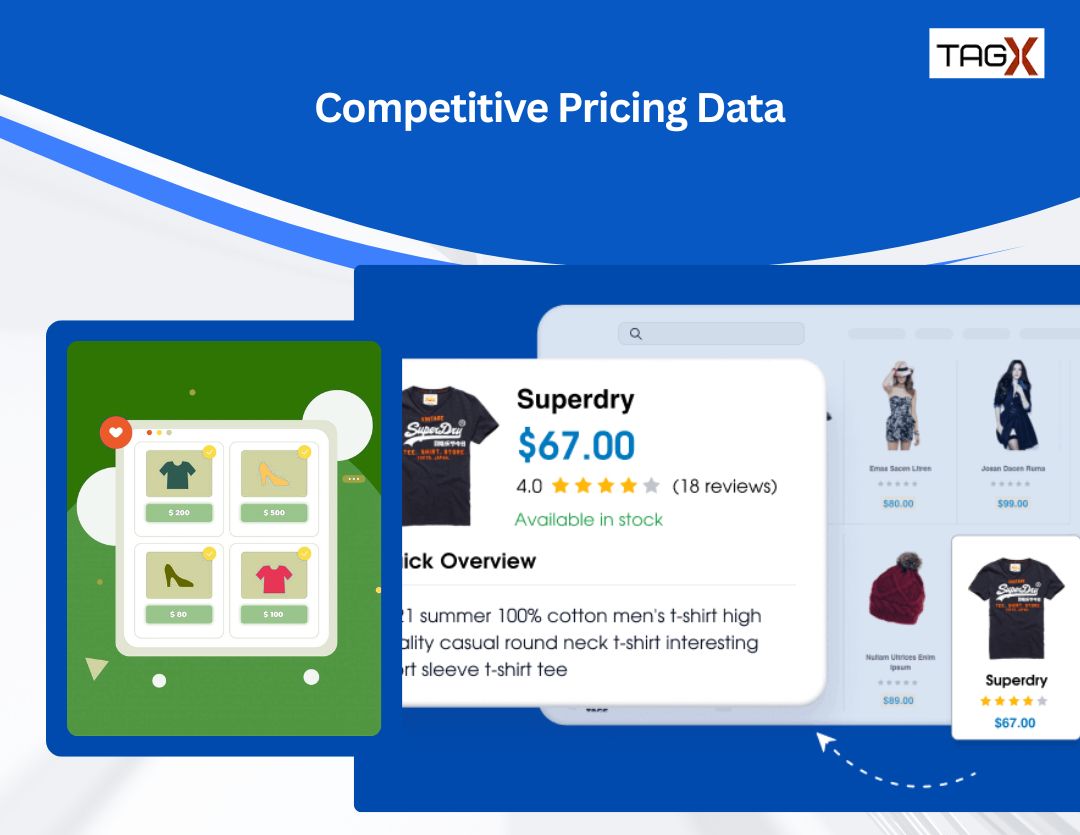
Best web scraping services for e-commerce price monitoring
Online pricing is more competitive than ever. Today’s shoppers compare prices across many stores before they buy, so even small price changes can affect sales. Because of this, many brands are turning to the Best web scraping services to support smarter e-commerce price monitoring and stay aware of competitor moves.
As ecommerce markets grow, businesses need reliable ways to track pricing trends without wasting time on manual work. This is where experienced providers like TagX help. Their managed data services support accurate ecommerce price tracking and give retailers the insights they need to make better pricing decisions. In this guide, you will learn what to look for in a provider, how data collection supports pricing strategy, and how to choose the right partner for your business.
Why Price Intelligence Matters for Modern Ecommerce Brands
The ecommerce space is crowded, and price is often the deciding factor for shoppers. Many customers open several tabs and compare options before they buy. Because of this behavior, brands can no longer guess their pricing strategy. They need clear visibility into the market. Strong ecommerce price tracking helps businesses see where they stand and react before they lose sales.
At the same time, profit margins are getting tighter across most retail categories. Shipping costs, ad spend, and marketplace fees continue to rise. If prices are set too high, conversion drops. If they are too low, margins suffer. This is why competitor price monitoring has become a core part of modern pricing strategy. Industry research shows that companies using data-driven pricing often see meaningful revenue improvements compared to those relying on manual pricing.
In short, price intelligence is no longer optional. It helps ecommerce brands stay competitive, protect margins, and respond quickly to market changes.
Read more: Top Web Scraping Services in the USA
How Businesses Monitor Competitor Prices at Scale
Many retailers try to monitor competitor prices using basic methods at first. In small catalogs, teams often rely on manual checks. They visit competitor sites, record prices in spreadsheets, and update reports by hand. This approach may work for a short time, but it quickly becomes slow and error-prone as the business grows.
As product catalogs expand, manual work cannot keep up with real market changes. This is where structured online price monitoring becomes essential. Automated data collection helps businesses track thousands of products across multiple marketplaces without constant human effort.
However, large-scale tracking comes with real challenges, such as:
- Frequent price changes across ecommerce sites
- Huge SKU volumes that are hard to track manually
- Inconsistent product matching between competitors
- Risk of missing critical pricing shifts
- Time and labor costs increase with catalog size
Because of these hurdles, growing ecommerce brands move toward managed data services that can handle scale reliably. When pricing visibility improves, businesses can react faster, protect margins, and stay competitive in fast-moving markets.
Role of Web Scraping in Retail Price Monitoring
Retailers today need fast and reliable access to pricing data to stay competitive. As online competition grows, manual tracking methods fall short. This is why many ecommerce brands now depend on structured data collection to support smarter pricing strategies. Web scraping for price monitoring has become a key driver of effective retail price monitoring, especially for businesses managing large product catalogs.
How Data Extraction Enables Accurate Tracking
Accurate pricing data is the backbone of a smart ecommerce strategy. This is where web scraping for price monitoring plays an important role. Instead of checking competitor sites one by one, businesses can automatically collect product prices, discounts, and stock status from multiple sources. This structured data makes retail price monitoring faster, more consistent, and easier to scale.
Expanding Coverage Across Online Marketplaces
Data extraction also helps brands track pricing across major marketplaces and niche retail sites at the same time. Whether a company sells on marketplaces, brand websites, or regional stores, broad coverage ensures no important price movement is missed. With the right data flow, teams can compare products, spot undercutting competitors, and adjust pricing with confidence.
Why Enterprises Rely on Managed Data Services
For growing retailers and enterprise brands, manual tracking is no longer practical. Large catalogs and fast price changes require dependable, managed services that deliver clean and timely data. This is why many organizations now rely on experienced providers to support their pricing intelligence efforts at scale.
Comparison of the Best Web Scraping Services for Ecommerce Price Monitoring
Choosing the right partner for ecommerce price scraping requires careful evaluation. Businesses should look at data accuracy, marketplace coverage, scalability, and the level of customization each provider offers. The Best web scraping services deliver clean, structured data and adapt to changing ecommerce demands.
Comparison Table of Leading Providers
Quick analysis:
TagX differentiates itself through its fully managed approach and strong customization capabilities, which are valuable for businesses that want ready-to-use ecommerce datasets without heavy internal effort. Other providers offer powerful infrastructure, but many require more hands-on technical management compared to TagX’s service-led model.
Get accurate ecommerce pricing data with TagX managed services today.
Key Features to Look for in the Best Web Scraping Services
Choosing among the Best web scraping services requires more than comparing prices. You need a provider that delivers reliable, clean, and scalable ecommerce data. The right partner helps brands track competitors, protect margins, and make faster pricing decisions.
Below are the most important features to evaluate before you commit.
Custom Data Extraction
Every ecommerce business has unique data needs. A strong service should capture product prices, availability, seller details, and promotions across multiple marketplaces.
More importantly, the data must be structured and cleaned before delivery. Quality providers transform raw web data into usable formats such as JSON or CSV and remove duplicates or inconsistencies.
TagX supports fully customized data collection based on each client’s catalog and competitive landscape.
Scalability for Growing Catalogs
Your data needs will grow as your product catalog expands. A reliable provider must handle thousands or even millions of SKUs without performance issues.
Enterprise-grade scraping infrastructure typically includes load balancing, retry logic, and distributed resources to maintain stable extraction at high volumes.
TagX is built to support both fast-growing retailers and large marketplaces that require consistent coverage at scale.
Accuracy and Validation
Bad pricing data leads to bad decisions. That is why validation and quality checks are critical.
High-quality services are performed:
- Field-level accuracy checks
- Deduplication and normalization
- Completeness verification
- Ongoing monitoring when websites change
Many advanced providers report accuracy rates close to 99 percent when strong QA processes are in place.
TagX follows a multi-step quality process to help ensure dependable ecommerce datasets.
Compliance and Ethical Data Practices
Responsible data collection matters more than ever. Businesses should work with providers that respect website policies, privacy expectations, and legal requirements.
Enterprise scraping programs typically include governance controls and monitoring to reduce compliance risks and maintain long-term data stability.
TagX emphasizes compliant, transparent data practices so ecommerce brands can scale price intelligence with confidence.
How Ecommerce Data Scraping Supports Smarter Pricing Decisions
Smart pricing starts with reliable data. Ecommerce data scraping helps brands collect product prices, discounts, stock status, and seller details from across the market. When this raw data is cleaned and organized, it becomes a powerful input for a pricing strategy. Instead of guessing, teams can see real market trends and respond with confidence.
One of the biggest advantages of ecommerce price scraping is competitor benchmarking. Businesses can compare their prices against key rivals across marketplaces and brand websites. This visibility helps teams spot underpricing, identify premium positioning opportunities, and avoid unnecessary margin loss. Over time, consistent benchmarking leads to more stable and competitive pricing decisions.
Here are a few common use cases:
- Dynamic repricing: Retailers adjust prices when competitors change theirs
- Assortment planning: Teams identify which products face the most price pressure
- Promotion tracking: Brands monitor competitor discounts during peak seasons
- Market entry analysis: Companies study pricing before launching in new regions
When used correctly, ecommerce data turns pricing into a strategic advantage rather than a reactive task.
Common Challenges in E-commerce Price Monitoring and How Experts Handle Them
While e-commerce price monitoring is essential for staying competitive, it is not always easy to execute at scale. Many ecommerce sites use advanced protections and complex page structures that make consistent data collection difficult. Without the right expertise, businesses often end up with incomplete or outdated pricing data.
Anti-Bot Protections and Access Barriers
One major hurdle is anti-bot protection. Many retailers actively block automated traffic to prevent large-scale data extraction. Experienced providers know how to manage these barriers responsibly while maintaining stable data flows. This ensures pricing visibility without frequent disruptions.
Rapid and Frequent Price Changes
Another challenge is the speed of price changes. Ecommerce prices can shift many times a day, especially during promotions or peak seasons. Manual tracking cannot keep up with this pace. The Best web scraping services use structured processes to capture frequent updates so businesses always work with fresh data.
Managing Large SKU Volumes
Large SKU volumes create serious complexity. Tracking thousands of products across multiple marketplaces requires strong infrastructure and smart product matching. Without proper systems, businesses risk gaps in coverage and delayed insights.
Data Normalization and Quality Control
Raw data from different sources often arrives in inconsistent formats. Data normalization is critical to clean, standardize, and organize pricing information into a usable structure. Skilled providers apply validation checks and formatting rules to ensure the data is ready for analysis.
Because of these challenges, many ecommerce brands rely on experienced service providers. Skilled teams bring the technical depth and quality controls needed to deliver accurate, scalable pricing intelligence that supports confident business decisions.
Read also: Best Web Scraping Companies for E-Commerce Data in 2026
Why Businesses Choose TagX Among the Best Web Scraping Services
When companies evaluate the Best web scraping services, they look for more than basic data delivery. They want reliability, flexibility, and a partner that understands complex ecommerce environments. TagX stands out by focusing on fully managed data services tailored to each client’s pricing and market intelligence goals.
Unlike one-size-fits-all providers, TagX follows a custom engagement model that adapts to different catalog sizes, marketplaces, and data requirements. This approach helps both fast-growing retailers and large enterprises scale their price monitoring programs with confidence.
Key reasons businesses choose TagX:
- Customized data workflows that align with specific ecommerce and competitive needs
- Scalable data collection built to handle large SKU volumes across multiple marketplaces
- Strong quality assurance processes that help ensure clean and reliable datasets
- Flexible delivery formats that integrate smoothly into existing analytics environments
- Experienced data teams that manage complex extraction challenges efficiently
- Compliance-focused practices that support responsible data collection
With its service-led approach and enterprise-ready capabilities, TagX continues to earn trust from brands that need dependable pricing intelligence at scale.
Conclusion
In today’s fast-moving e-commerce market, pricing visibility is no longer optional. Brands that invest in strong price intelligence are better positioned to respond to competitors, protect margins, and capture more conversions. Accurate data helps teams move from reactive pricing to confident, strategy-driven decisions.
As competition continues to grow, choosing from the Best web scraping services becomes a critical business decision. The right partner will not only deliver clean data but also support your long-term pricing and market intelligence goals.
If your business is ready to strengthen its ecommerce pricing strategy, TagX can help. Their managed data services are designed for retailers and enterprises that need reliable, scalable pricing insights without heavy internal effort. Connect with the TagX team today to discuss your requirements and explore how customized data delivery can support your growth.